Contents
- The ecosystem of talent, finance, and professional services created by a hub through which global capital flows
- Singapore’s SFOs Have Exceeded 2,000
- The Work Created Around Family Offices
- Singapore as a Place Through Which Global Capital Flows
- Why Does Enormous AUM Matter Economically?
- What Lies Beyond the Government’s Aim to Attract Wealthy Individuals
- Finance Is One of Singapore’s Growth Engines
- What Is Japan Lacking?
- From a Place to Sell Products to a Place to Connect
- Creating an Ecosystem, Not Networking
The ecosystem of talent, finance, and professional services created by a hub through which global capital flows
Does “attracting family offices” simply mean bringing in wealthy individuals and their assets?
When attending family office-related events in Singapore, it becomes clear that the answer is no.
The participants are not limited to Single Family Offices (SFOs), Multi-Family Offices (MFOs), and private banks.
The businesses surrounding family offices have become finely specialized, including asset management companies, funds, Fund of Funds, insurance brokers, lawyers, tax and trust professional advisers, and businesses that source investment opportunities and connect them with family offices.
More recently, major asset management companies that were traditionally seen as having a strong institutional investor business have also been expanding their points of contact with the private wealth market.
What matters is not simply that “there are many wealthy individuals.”
In Singapore, an ecosystem has formed around global capital, connecting asset management companies, financial institutions, professional advisers, investment opportunities, and talent.
Singapore’s SFOs Have Exceeded 2,000
Behind this is the rapid concentration of asset administration functions in Singapore.
According to the Singapore Economic Development Board (EDB), the number of SFOs in Singapore exceeded 2,000 as of the end of 2024. It is also said that there are more than 1,900 professional investment professionals.
Of course, SFOs are not uniform in size or function.
Even so, when this many family offices gather in a single city-state, what is needed is not only offices and bank accounts.
A wide range of work emerges around them: people who manage assets, financial institutions that administer assets, people who search for investment opportunities, professional advisers who support legal and tax matters, and people who consider succession and governance.
The growth of family offices is also the growth of the industries that exist around them.
The Work Created Around Family Offices
A family office is not something that is complete simply because it has been established.
For asset administration and investment management, custodian banks, Investment Managers, and External Asset Managers (EAMs) are needed.
In the investment field, there are Fund Managers, Fund of Funds, and professional advisers who source and evaluate investment opportunities, including in private markets.
In addition, lawyers, tax professional advisers, Trustees, and specialists in insurance for wealthy individuals are needed to support legal, tax, and succession matters.
The areas that cannot be completed through investment management alone, such as family governance, philanthropy, and education of the next generation, are also expanding.
In other words, the “family office legal entity” itself is not the industry.
Rather, expertise in investment management, finance, law, tax, trusts, insurance, investment, governance, and other areas gathers around it, forming an economic sphere centered on family wealth.
Singapore as a Place Through Which Global Capital Flows
Understanding this structure requires looking at Singapore’s investment management market.
Singapore is not a market that manages only the assets of its own wealthy residents. It has developed as an international asset management hub that gathers capital from around the world and allocates it to Asia and the rest of the world.
[Figure: Singapore’s assets under management (AUM) have approximately doubled in seven years]
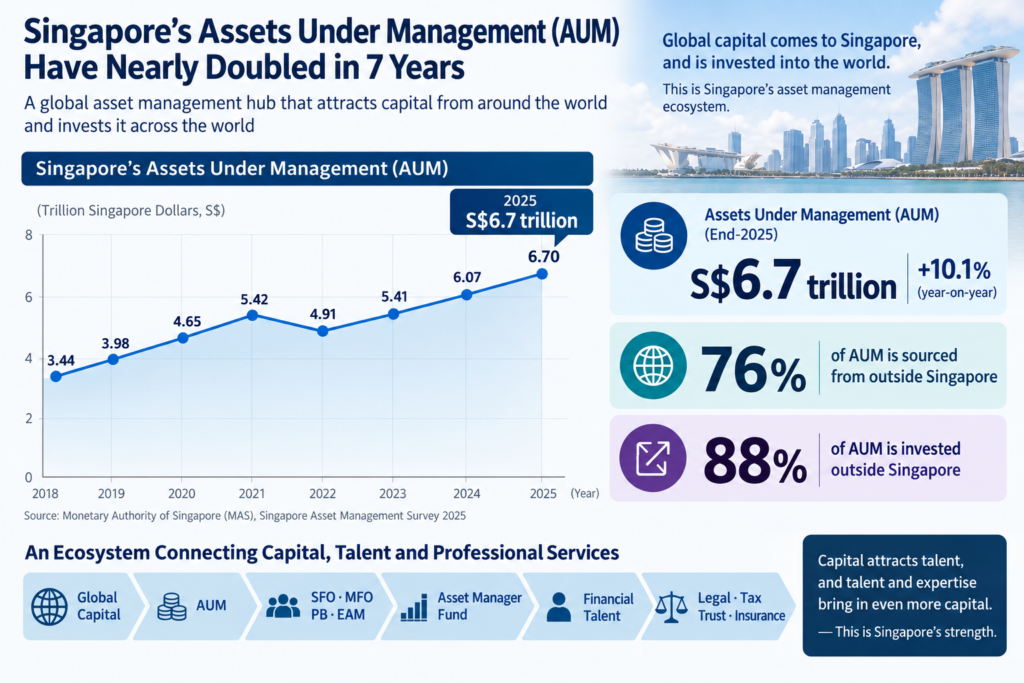
As shown in the figure, Singapore’s assets under management (AUM) reached S$6.7 trillion in 2025.
What is even more distinctive is the flow of funds. Seventy-six percent of AUM is sourced from outside Singapore, and 88% of managed assets is invested overseas.
This clearly reflects Singapore’s characteristics as a financial hub.
It is not gathering enormous overseas capital and investing all of it domestically in Singapore.
Rather, the structure is as follows:
Gather capital from around the world
→ manage and invest it in Singapore
→ invest it back into the world
In other words, what Singapore is bringing in is not only the funds themselves.
It is concentrating domestically the very functions of “administering, managing, and allocating” global capital.
Why Does Enormous AUM Matter Economically?
This is a very important point.
AUM is not government revenue, nor is the full amount consumed or invested within Singapore. Therefore, it cannot be simply compared with the national budget or GDP.
Even so, becoming a base for administering and managing enormous global assets has major economic significance.
Banks are needed to administer assets. Asset Managers, EAMs, and fund managers are needed to manage them. If investments are made in private markets, talent is also needed to source and evaluate opportunities.
In addition, professional services such as lawyers, tax professional advisers, Trustees, insurance, and fund administration are needed around them.
Once such functions are concentrated, highly skilled financial talent also becomes easier to attract.
As a result,
capital attracts talent, talent develops professional services, and that expertise attracts further capital.
This cycle is created.
Singapore’s strength does not lie simply in the fact that it “attracted wealthy individuals.”
It lies in having become a place through which global capital flows, thereby forming high-value-added work and industries around that flow.
What Lies Beyond the Government’s Aim to Attract Wealthy Individuals
Seen in this way, Singapore’s family office policy looks different.
The policy objective is not merely to increase the “number” of SFOs.
Alongside attracting asset administration bases, Singapore has also emphasized points of contact with the Singapore economy and society, including the development of financial and professional talent, investment, and philanthropy.
The government has pointed out that the economic effects brought by SFOs include not only direct employment by the SFOs themselves, but also employment created at external service providers such as banks and law firms.
In fact, as of June 2022, SFOs that received certain tax incentives alone employed approximately 1,400 Singapore citizens and Permanent Residence holders.
The SFO route under the Global Investor Programme (GIP) also includes mechanisms that require substantive points of contact with the Singapore economy, such as certain investments and the employment of family office professionals.
In other words, the idea is to connect:
Private Capital
→ Asset Management
→ Financial Talent
→ Professional Services
→ Investment and Employment
Attracting wealthy individuals is only the entry point.
Finance Is One of Singapore’s Growth Engines
Of course, it would not be appropriate to simplify the picture by saying that “family offices and the financial industry support Singapore’s economy.”
Singapore has several strong industries, including manufacturing, wholesale trade, logistics, and information and communications.
At the same time, finance and insurance is one important industry that attracts capital and highly skilled talent from overseas.
According to Singapore’s Ministry of Trade and Industry (MTI), GDP growth in 2025 was driven mainly by outward-oriented industries, and the three sectors of manufacturing, wholesale trade, and finance and insurance accounted for 62.1% of GDP growth.
Furthermore, in the second quarter of 2026, finance and insurance recorded year-on-year growth of 6.2%.
Singapore, a city-state with few natural resources, has built a mechanism for attracting capital and talent from overseas and converting them into domestic expertise, employment, and added value.
Family offices are also part of this larger financial ecosystem.
What Is Japan Lacking?
So what is Japan lacking?
Japan also has wealthy individuals and business owners.
In each field, there are players with high levels of expertise, including asset management companies, banks, securities companies, funds, lawyers, tax accountants, and insurance companies.
In other words, it is not necessarily the case that individual players are lacking.
One issue may be that opportunities for these players to connect across fields as a single ecosystem around family offices and family wealth remain limited.
Asset management companies tend to operate within the asset management company community, banks within the banking community, and licensed professionals within their own professional communities.
Moreover, there is still room to further develop continuous points of contact between overseas family office communities in Singapore, Hong Kong, and elsewhere, and Japanese asset management companies and professional advisers.
What Japan needs is not only to create new players from scratch.
The key question is how to connect existing players across industries, organizations, and even national borders.
This perspective is important.
From a Place to Sell Products to a Place to Connect
What matters here is not to turn the family office community into a place where wealthy individuals are gathered so that financial products and services can be sold to them.
Family offices and Wealth Owners; Asset Managers and General Partners (GPs); PBs, EAMs, and MFOs; professional advisers such as lawyers and tax accountants; people involved in the next generation and business succession; and overseas family office communities.
It is important for these different players to bring their expertise, share insights in a trusted environment, and build long-term relationships.
If events are held, people gather, and business cards are exchanged, a network can be formed.
But that alone does not make an ecosystem.
From there, collaboration with professional advisers, investment opportunities, joint projects, the next generation and business succession, and overseas connections must continue to emerge, attracting further talent and expertise.
Only when that cycle is created does a network become an ecosystem.
Creating an Ecosystem, Not Networking
What Japan can learn from Singapore is not the “number” of SFOs itself.
Behind more than 2,000 SFOs is an investment management market of S$6.7 trillion, along with capital gathered from around the world, financial institutions and asset management companies that administer and manage that capital, financial talent, and professional services in law, tax, and other fields.
As these elements connect with one another, a cycle emerges that attracts new capital, talent, and investment opportunities.
Japan also has excellent players in each field.
The challenge is to connect them across fields, both domestically and internationally, and develop those connections into continuing relationships.
Creating an ecosystem, not networking.
The Family Office Practitioners Association of Japan (FOPAJ) does not aim merely to increase one-off exchanges or opportunities to exchange business cards.
Rather than aiming to sell specific products or services, its objective is to create an environment in which family offices, asset management companies, financial institutions, professional advisers in law and tax, and overseas family office communities bring their expertise together, allowing insights, talent, and investment opportunities to circulate continuously.
The goal is not only to “attract assets,” but to “create a mechanism through which capital, talent, and expertise continue to gather.”
The objective is not merely to have global capital invested within Japan. It is to create reasons for global capital to “flow through” Japan, and in that process to accumulate investment management functions, talent, and professional services domestically.
Singapore’s experience shows the importance of this perspective as Japan seeks to form a family office ecosystem.
References
Monetary Authority of Singapore (MAS), Singapore Asset Management Survey Report 2025, July 2026.
Singapore Economic Development Board (EDB), Global Business Families
Singapore Economic Development Board (EDB), With surge in family offices, Singapore aims to boost charitable giving, 3 September 2025
Singapore Economic Development Board (EDB), Family offices in spotlight over how much value they bring to Singapore, 10 July 2023
Singapore Economic Development Board (EDB), Global Investor Programme
Singapore Ministry of Trade and Industry (MTI), Written reply to PQ on impact of government-issued vouchers and credits on 2025 GDP growth, 12 February 2026
Singapore Ministry of Trade and Industry (MTI), Written reply to PQ on Addressing risks of Disproportionate Growth in Electronics Manufacturing versus Domestic-facing sectors and measures to mitigate concentration risks, 8 September 2026
This article summarizes Singapore’s ecosystem surrounding family offices from a practitioner’s perspective based on publicly available materials and other sources, and does not recommend any specific financial product or service, investment, or jurisdiction.