Before Planning Overseas Relocation Share Sales and Wealth Succession
Key Points
- Beginning with income tax for 2027, the minimum tax on high-income individuals will be strengthened. The special deduction amount will be reduced from JPY 330 million to JPY 165 million, and the tax rate will rise from 22.5% to 30%.
- When a business owner with substantial unrealized gains in shares of their own company or other assets considers relocating overseas, Japan’s exit tax regime may apply.
- What matters is not a simple comparison of tax rates, but a long-term, integrated view of the family’s places of residence, shares in the owner’s company and financial assets, the business, and wealth succession.
Relocating overseas, establishing an overseas company, setting up a family office, and transferring wealth to the next generation.
For Japanese business owners and high-net-worth individuals, managing assets and businesses across national borders is no longer as unusual an option as it once was.
At the same time, Japan’s tax system is also changing.
Two regimes are particularly important for business owners: taxation on departure from Japan, commonly called the “exit tax,” and the “special measure to ensure an appropriate tax burden on extremely high levels of income.” For convenience, this article refers to the latter as the “minimum tax on high-income individuals.”
The former may become relevant when a person holding specified assets moves from Japan to another country. The latter requires individuals earning extremely high levels of income to bear an income tax burden above a certain level.
These are entirely separate regimes. Their relationship cannot be reduced to the proposition that a person will be taxed whether they remain in Japan or move abroad.
For business owners with substantial unrealized gains in shares of their own companies, however, both regimes highlight the same underlying issue: it is becoming difficult to consider separately when to sell, where to live, and to whom the assets will be transferred.
Contents
- Strengthening the Minimum Tax on High Income Individuals from 2027
- New JPY 165 Million Deduction and 30 Percent Rate from 2027
- Why the Measure Matters to Business Owners
- Overseas Relocation Before a Share Sale and the Exit Tax Regime
- What Taxation Before a Sale Means
- A Cross Border Issue Can Arise Even Without the Owner Relocating
- The Choice Is Not Simply Between Remaining in Japan and Moving Abroad
- Start with the Family Assets and Business Rather Than the Tax Rate
- From Tax Reduction to Long Term Planning
- Conclusion See the Full Picture Before Crossing Borders
- Notes
- Principal References
Strengthening the Minimum Tax on High Income Individuals from 2027
The first measure to understand is the “special measure to ensure an appropriate tax burden on extremely high levels of income.”
This measure was introduced in the fiscal 2023 tax reform and has applied to income tax for 2025 and subsequent years.
Under the current regime, if the base income amount for a year exceeds JPY 330 million, the following calculation applies:
(Base income amount − JPY 330 million) × 22.5%
The resulting amount is compared with the “base income tax amount.” If the calculated amount is higher, the difference is added to the individual’s income tax liability.
Accordingly, this is not a regime that uniformly imposes an additional 22.5% tax on the portion of income exceeding JPY 330 million.
The base income amount includes not only employment and business income but also capital gains from shares and other securities, as well as gains from transfers of land and buildings.
In other words, the measure does not concern only people who receive enormous salaries every year.
It is also important for business owners who founded a company, saw the value of their shares rise substantially over many years, and then sell those shares.
New JPY 165 Million Deduction and 30 Percent Rate from 2027
Even more important is the fiscal 2026 tax reform.
Beginning with income tax for 2027, the special deduction amount used to calculate the additional burden will be reduced from JPY 330 million to JPY 165 million, while the tax rate will rise from 22.5% to 30%.
The basic calculation after the reform will be:
(Base income amount − JPY 165 million) × 30%
The resulting amount will be compared with the base income tax amount.
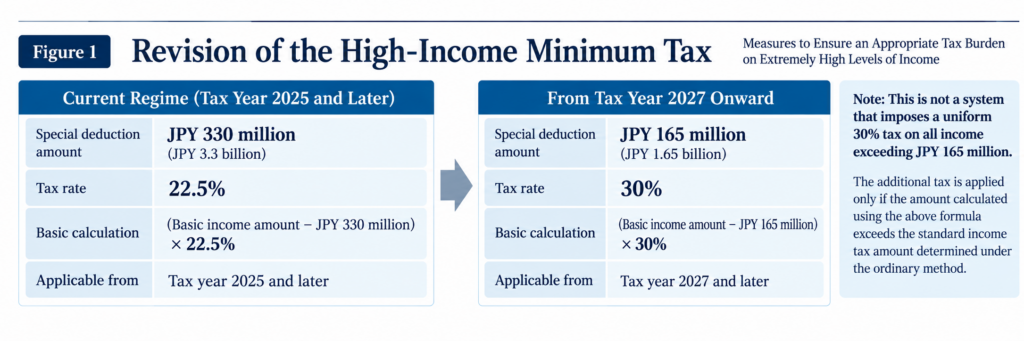
Figure 1 Changes to the Minimum Tax on High Income Individuals
The important point is that this is not a regime that uniformly taxes income exceeding JPY 165 million at 30%.
The amount calculated using the formula above is compared with the base income tax amount. Only when the former is higher is the difference added to the individual’s income tax liability.
Why the Measure Matters to Business Owners
This measure matters to business owners because Japan’s income tax treatment differs depending on the type of income.
For example, progressive tax rates apply to employment and business income, while capital gains from shares and other securities are subject to a separate tax framework.
As a result, even individuals earning extremely high levels of income may face different effective income tax rates depending on the composition of that income. The measure was introduced to promote fairness in the tax burden in light of this situation.
A typical example involving a business owner is the sale of shares in the founder’s own company.
For instance, after a founder has grown a company over many years and the value of the shares has increased substantially, the founder may sell some or all of those shares. The sale may realize a substantial capital gain.
The measure therefore concerns not only annual income but also major capital transactions that may occur only a few times in a business owner’s life, such as an M&A transaction or a sale of shares following an IPO.
Overseas Relocation Before a Share Sale and the Exit Tax Regime
When shares in an owner’s company have substantial unrealized gains, the timing of an overseas relocation and a share sale may also be considered.
This is where taxation on departure from Japan, commonly called the “exit tax,” must be examined.
Japan introduced the exit tax regime in July 2015.
When a qualifying resident departs from Japan, unrealized gains on specified assets may be subject to tax even if those assets have not actually been sold. In general, the regime may apply when the total value of the specified assets is at least JPY 100 million and the individual has maintained a domicile or residence in Japan for more than five years in aggregate during the ten years preceding the date of departure, along with other applicable requirements.
Specified assets include securities such as shares and investment trusts, interests in silent partnership agreements, and unsettled margin and derivatives transactions.
Here again, shares in the owner’s company are particularly important for business owners.
The relevant securities are not limited to listed shares. Unlisted shares in the owner’s company may also fall within the regime.
Consequently, an overseas relocation may trigger exit tax considerations even before the company has been sold or the owner’s shares have been converted into cash.
What Taxation Before a Sale Means
This can create an issue specific to business owners.
Suppose, for example, that shares in the owner’s company had almost no value when the company was founded but became highly valuable through many years of business growth.
The appraised value of the assets may be substantial. If most of that value consists of shares in the owner’s company, however, the owner may not hold a corresponding amount of cash.
Because the exit tax regime may in certain circumstances tax unrealized gains even when the shares have not actually been sold, a mismatch can arise between asset value and the liquidity needed to pay the tax.
Nevertheless, tax deferral may be available if prescribed procedures are completed, including filing a notice appointing a tax representative before departure from Japan, and if requirements such as providing the necessary collateral are satisfied.
The tax deferral period is generally five years and may be extended to a maximum of ten years by filing for an extension.
The existence of an exit tax therefore does not mean that relocating overseas is impossible.
The key is not to review the tax implications only after deciding to relocate, but to consult professional advisers while relocation is still under consideration regarding matters such as the valuation and acquisition cost of shares in the owner’s company, unrealized gains, liquidity, and eligibility for tax deferral.
A Cross Border Issue Can Arise Even Without the Owner Relocating
Another easily overlooked point arises in connection with the exit tax regime.
The issue is not limited to cases in which the owner relocates overseas.
Related rules may also apply when specified assets are gifted by a resident who meets prescribed requirements to a non-resident, or when such assets pass to a non-resident by inheritance or bequest. In the case of inheritance, requirements include specified assets valued at JPY 100 million or more and, in general, the decedent having maintained a domicile or residence in Japan for more than five years in aggregate during the preceding ten years.
This is also important in family office practice.
For example, a parent who founded the business may continue to live in Japan, while a child attends university abroad, obtains employment there, and establishes a permanent base in that country.
In such circumstances, it becomes difficult to separate the question:
“Who will live where?”
from the question:
“Which assets will be transferred to whom, and when?”
These two questions can no longer be considered independently.
The internationalization of a family therefore also leads directly to the internationalization of its wealth succession.
The Choice Is Not Simply Between Remaining in Japan and Moving Abroad
The discussion so far might suggest a binary choice:
“Sell the shares while continuing to live in Japan and face the minimum tax on high-income individuals, or move abroad and face the exit tax.”
That framing may appear plausible.
It is not accurate, however.
The minimum tax on high-income individuals and the exit tax regime are independent systems with different covered persons, covered income or assets, taxable events, and calculation methods.
In actual cross-border tax matters, many other rules may also be relevant, including the determination of tax residence or non-residence, inheritance and gift taxes, foreign tax credits, tax treaties, and the controlled foreign company (CFC) rules when an overseas company is owned.
The important question is therefore not simply which country offers the lowest tax rate.
Start with the Family Assets and Business Rather Than the Tax Rate
For business owners, personal assets and the business are closely connected.
The owner relocates overseas. A child settles abroad. Shares in the owner’s company are sold. The operating company is sold through an M&A transaction. The shares are transferred to the next generation. An overseas company or family office is established.
These may appear to be separate decisions, but they are interconnected from the perspectives of tax, law, investment management, and business succession.
For this reason, family office practice requires an integrated view of:
the individual’s place of residence
× the family’s places of residence
× shares in the owner’s company and financial assets
× the operating company
× wealth succession
× family governance
All of these elements must be considered together.
For a business owner whose company shares have become highly valuable, the current year’s tax burden is not the only important consideration.
Who will own the company in five or ten years? Who will manage it? Where will the family live? How will the assets be held?
Current asset administration and succession planning must be considered by working backward from that future state.
From Tax Reduction to Long Term Planning
Discussions of exit tax and the minimum tax on high-income individuals can easily become focused on how to reduce taxes.
Family office practice, however, is not solely about tax reduction.
What matters is a long-term plan for managing and transferring the family, its assets, and its business across multiple generations and jurisdictions.
This requires the intersection of multiple areas of expertise, including not only tax but also law, investment management, business succession, family governance, and education of the next generation.
No single professional adviser can make every judgment involved.
It is important to understand the full picture across the different areas of expertise represented by tax accountants, lawyers, certified public accountants, financial institutions, asset management companies, and family office practitioners.
This is one reason to view a family office not merely as an investment management mechanism, but as a form of long-term governance for the family as a whole.
Conclusion See the Full Picture Before Crossing Borders
Beginning with income tax for 2027, the minimum tax on high-income individuals will be strengthened. The special deduction amount will be reduced from JPY 330 million to JPY 165 million, and the tax rate will rise from 22.5% to 30%.
When a person relocates from Japan to another country, the exit tax regime may apply if requirements relating to assets, period of residence, and other matters are satisfied.
This is not simply a question of whether one should remain in Japan or move abroad.
Rather, as the rules become more complex, it becomes increasingly important to:
place the family, its assets, and its business on the same timeline and work backward from the future.
That may be the more useful question to ask.
As cross-border movement of people, capital, and businesses becomes commonplace worldwide, tax systems are also adapting to assets and income that cross national borders.
For business owners and their families, it is more important than ever to consider overseas relocation, share sales, business succession, and the establishment of a family office not in isolation, but as parts of long-term asset administration and family governance.
Notes
This article presents general information on Japan’s exit tax regime and the “special measure to ensure an appropriate tax burden on extremely high levels of income,” based on materials published by the National Tax Agency, the Ministry of Finance, and other authorities as of September 2026. It does not provide individual tax or legal advice or recommend any specific transaction, overseas relocation, asset transfer, or other action.
Actual tax treatment varies depending on factors including residence status, the type, appraised value, and acquisition cost of assets, the nature of income, family composition, the circumstances of relevant entities and transactions, and the applicable date. Consult a tax accountant, lawyer, or other appropriate professional adviser before making a specific decision.
Principal References
National Tax Agency, “Special Taxation Rule for Specified Base Income Amounts”
National Tax Agency, “Special Rule for Capital Gains and Other Income upon Departure from Japan”
Ministry of Finance, “Overview of the Fiscal 2026 Tax Reform Outline”
Ministry of Finance, “Fiscal 2026 Tax Reform and Related National Tax Measures”