Contents
- India Has NRIs What About Japanese Nationals
- Where Do Japanese Residents Sit in the Global Financial System
- A Product Existing Overseas Does Not Mean It Can Be Offered to a Japanese Resident
- Private Banking Also Changes with Residence
- Insurance Makes the Importance of Residence Especially Clear
- What Changes When the Center of Life Moves to Singapore
- Tax Treatment Also Changes When Moving from Japan to Singapore
- Residence Matters for Gifts and Inheritance
- Holding Assets Overseas and Living Overseas Are Fundamentally Different
- Is NRJ Status More Advantageous
- Why the NRJ Perspective Matters Now
- Before Asking What to Buy Ask Who Owns It and Where They Are
- Notes and References
During a recent meeting with a Singapore wealth management platform, an interesting question arose: what differs, from a wealth management perspective, between a Japanese national living in Japan and one living abroad, such as in Singapore?
To an overseas financial institution, both are Japanese clients. In international finance, however, they are not situated in the same way. A Tokyo resident and a Japanese national whose center of life is in Singapore may be interested in the same foreign private bank, fund, or insurance product, yet their access to products and services, the ability of institutions to solicit or serve them, their tax treatment, and their reporting obligations may differ.
A passport alone does not determine where a Japanese client sits within the global financial system. Residence matters. This article compares Japanese residents with Japanese nationals who have moved their center of life overseas and examines why their wealth management choices may differ.
India Has NRIs What About Japanese Nationals
International finance frequently uses the term Non-Resident Indian (NRI). The Reserve Bank of India defines NRIs and provides financial arrangements designed for them, including NRE and NRO accounts. “Overseas Chinese” is also widely used, and Chinese communities abroad are recognized as an important wealth management client base.
No equally established term is widely used in Japanese financial and tax practice to identify Japanese nationals living overseas as a wealth management category. Yet practical analysis requires a distinction between Japan-Resident Japanese and Non-Resident Japanese. This article therefore uses “Non-Resident Japanese (NRJ)” as a convenient descriptive term for Japanese nationals whose center of life is abroad.
NRJ is not a legally defined Japanese category, and it does not automatically coincide with “non-resident” under Japan’s Income Tax Act. It is a perspective for analyzing international wealth management.
Where Do Japanese Residents Sit in the Global Financial System
Residence in Japan does not prevent overseas investment. Subject to the rules of the institution and jurisdiction, a Japanese resident may hold an account with an overseas bank or securities firm and remit funds abroad. Nevertheless, the person generally connects to international markets as an investor within Japan’s regulatory and tax framework.
The world offers many funds, insurance products, private-market investments, and wealth management services that are not common in Japan. This issue is not limited to private equity and hedge funds. Even among exchange-traded funds, not every ETF listed in the United States can be purchased through a Japanese securities firm. Soliciting and selling a foreign ETF in Japan may require filings and disclosure under the FIEA, the Investment Trusts Act, and related rules, so domestic securities firms handle only a subset.
A product’s listing in New York and a Japanese resident’s ability to access it through a Japanese financial institution are not the same thing. This distinction is fundamental to international wealth management.
A Product Existing Overseas Does Not Mean It Can Be Offered to a Japanese Resident
The same principle applies to overseas financial institutions. The FSA states that even an overseas operator generally must register under the FIEA when it conducts financial instruments business for or with Japanese residents.
The existence of an institution overseas is therefore separate from its ability to offer products or services to a Japanese resident. Policies vary: some institutions decline new Japanese-resident clients, while others maintain existing accounts but restrict new purchases, investment advice, or other services. Certain products and services may be available only to customers with specified attributes, such as QII or Specified Investor status.
The central question is not merely whether a client can open an overseas account, but what the institution is permitted and willing to provide to a customer with that residence and investor classification.
The following chart summarizes the key differences in wealth management between Japanese nationals residing in Japan and those residing in Singapore, covering financial regulations, investment access, private banking, insurance, taxation, and inheritance.
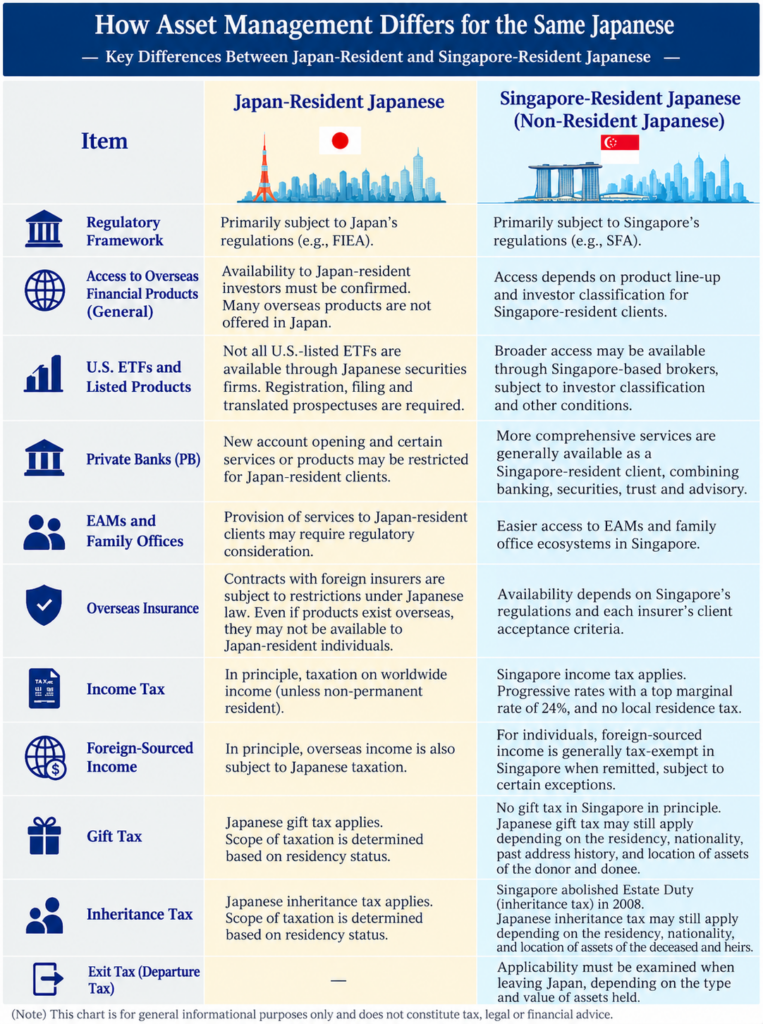
Figure 1. Comparison of Wealth Management Environments for Japan-Resident and Singapore-Resident Japanese Nationals
Source: Family Office Practitioners Association of Japan (FOPAJ). Prepared for general informational purposes. Actual treatment may vary depending on individual circumstances, residency status, and applicable regulations.
Private Banking Also Changes with Residence
A private bank is not simply a distributor of financial products to wealthy clients. It is a financial platform integrating functions across banking, securities, asset administration and custody, lending, trusts, and succession for wealthy individuals and owner families.
It safeguards and administers assets and uses the custody account to provide access to equities, bonds, funds, and alternative investments. It may also provide securities-backed finance, succession services, and coordination with corporate-banking or investment-banking teams supporting an owner’s business.
Singapore has developed an ecosystem in which an EAM can manage assets held through a private-bank custody account and a family office can select among multiple banks and asset management companies. The private bank is thus a platform connecting financial functions and managers, not merely a place that sells products.
When a client’s center of life is in Singapore, the client’s residence aligns with the location of that ecosystem. For a Japanese resident, a separate question arises: which services may the overseas private bank provide to a Japan-resident customer? Even with the same nationality and wealth, the institution may classify a Tokyo resident differently from a Singapore resident.
Insurance Makes the Importance of Residence Especially Clear
Residence is also critical for insurance. As a general rule, a foreign insurer that has not established a licensed branch or similar presence in Japan is restricted from entering into insurance contracts covering persons domiciled or resident in Japan. Exceptions and a mechanism for obtaining prescribed prior approval may apply, but the existence of an attractive overseas policy does not mean that a Japanese resident can use it freely on the same terms.
For a Singapore resident, availability is assessed under Singapore regulation and the insurer’s customer-acceptance standards. The same Japanese national considering the same overseas insurer may therefore receive a different answer depending on whether the person lives in Tokyo or Singapore. The existence of a product and a person’s eligibility to use it are separate questions.
What Changes When the Center of Life Moves to Singapore
Consider a move from Japan to Singapore. The passport does not change; residence does. From an overseas institution’s perspective, the customer profile may shift from “Japan-resident Japanese client” to “Singapore-resident Japanese client,” changing the regulatory environment for the provision of financial services.
Singapore hosts global private banks, EAMs, fund managers, insurers, lawyers, tax advisers, and trustees. When services are provided to a Singapore resident, availability is assessed in light of Singapore regulation and each institution’s acceptance policies.
This does not mean that moving to Singapore provides unrestricted access to every financial product. Singapore has investor-protection rules, investor-eligibility requirements, sales restrictions, and institution-specific KYC and suitability reviews. Relocation does not eliminate regulation; it changes the financial and tax framework that applies.
Tax Treatment Also Changes When Moving from Japan to Singapore
Residence changes the tax analysis as well as the available financial services. Under Japan’s Income Tax Act, an individual who has a domicile in Japan or has maintained a residence in Japan continuously for at least one year is generally a resident. “Domicile” means the person’s center of life, not merely the location recorded on a resident register.
Japanese residents other than non-permanent residents are generally subject to Japanese income tax on income earned both in Japan and abroad. Moving assets to an overseas private bank does not automatically remove the assets or investment income from the Japanese tax framework.
If a person moves the center of life abroad and becomes a non-resident for Japanese tax purposes, Japanese income tax generally applies to Japan-source income, while the tax system of the new country of residence becomes important. In Singapore, resident individuals are subject to progressive income tax with a current top rate of 24%. There is no local income tax equivalent to Japan’s inhabitant tax, and the standard corporate income tax rate is 17%. Subject to exceptions, foreign-sourced income remitted to Singapore by a resident individual is generally not taxed. This differs substantially from managing wealth as a Japanese resident on a worldwide-income basis.
Residence Matters for Gifts and Inheritance
Singapore has no general gift tax comparable to Japan’s, and Estate Duty was abolished for deaths occurring on or after February 15, 2008. Yet a Japanese national does not immediately leave the Japanese gift- and inheritance-tax framework merely by moving to Singapore.
For gift tax, the scope of property taxable in Japan may depend on where the donor and recipient are domiciled, whether they hold Japanese nationality, whether either had a domicile in Japan during the previous ten years, and whether the transferred property is situated in or outside Japan.
- Where are the donor and recipient domiciled?
- Do they have Japanese nationality?
- Did they have a domicile in Japan within the past ten years?
- Is the gifted property situated in Japan or overseas?
When specified conditions are met, Japanese gift tax may be limited to property situated in Japan, leaving foreign property outside its scope. Conversely, foreign property may remain taxable for Japanese nationals who moved abroad only recently. It is therefore inaccurate to assume that living overseas for ten years uniformly eliminates Japanese gift tax.
Inheritance requires a similarly fact-specific review of the nationality and residence of the decedent and heirs, their prior domicile history, and the location of assets. Relocation is not simply a move to a lower-tax country; it changes which countries’ rules must be considered across income, investments, ownership, gifts, and inheritance.
Holding Assets Overseas and Living Overseas Are Fundamentally Different
A person who lives in Tokyo while holding assets at a Singapore bank is not in the same position as someone who moves the center of life to Singapore. The former is essentially a Japan-resident client holding foreign assets. The latter connects to the financial system as a Singapore-resident client. Not only the location of the assets but also the location of the person who owns them has changed. This is the principal reason to distinguish Japan-Resident Japanese from Non-Resident Japanese.
Is NRJ Status More Advantageous
Residence in another country may broaden options because tax systems and available financial services differ. From a family office perspective, however, residence cannot be chosen solely by comparing product counts or tax rates.
- Where will the business operate?
- Where will shares in the company be held?
- Where will the spouse live?
- Where will the children be educated?
- Where do the parents live?
- What will happen to Japanese real estate?
- In which country might a future inheritance arise?
- Above all, where does the individual want the center of life to be?
A move from Japan may also require consideration of Japan’s exit tax regime, depending on the type and value of assets held. Becoming a Japanese non-resident, viewed in isolation, does not determine whether the family’s overall wealth management position is better or worse. A family office must integrate tax, investment management, business, inheritance, education, and family life.
Why the NRJ Perspective Matters Now
It is no longer unusual for Japanese corporate executives, start-up founders, investors, and professionals to maintain a base overseas. Some manage businesses and wealth across Singapore, Hong Kong, Dubai, London, New York, and other locations. Others remain in Japan while holding foreign assets or considering overseas institutions and products.
International wealth management therefore needs to ask not only whether a client is Japanese, but where that Japanese client resides. Overseas institutions cannot determine regulation and service eligibility by treating every customer simply as a “Japanese client.” Japanese advisers likewise must expand from a Japan-only analysis to one encompassing the tax, financial-regulatory, and succession systems of multiple countries when a client moves the center of life abroad.
Before Asking What to Buy Ask Who Owns It and Where They Are
Investment discussions tend to begin with which stock to buy, which fund is best, or which private bank to use. International wealth management must begin earlier: Who owns the assets? Where does that person reside? Where are the assets located? Which countries’ tax, financial-regulatory, and succession systems apply?
The answers differ between a Japanese national whose center of life is in Tokyo and one whose center of life is in Singapore. Nationality remains the same, but the market to which the person belongs as a customer within the global financial system may change.
A recent conversation with an overseas wealth management platform reinforced that “Japanese client” is no longer sufficient to describe the wealth management position of Japanese nationals. Viewed through the NRJ perspective, moving abroad is not merely changing the country of residence. It also changes how the individual connects to the global financial system.
Notes and References
National Tax Agency, No. 2875 Classification of Residents and Non-Residents
National Tax Agency, No. 2012 Determination of Resident or Non-Resident Status
National Tax Agency, No. 2873 Taxation of Non-Residents and No. 2878 Scope of Japan-Source Income
National Tax Agency, materials on overseas remittance records
National Tax Agency, materials on statements of assets and liabilities and overseas assets
National Tax Agency, materials on the exit tax regime
National Tax Agency, No. 4432 When the Recipient of a Gift Resides Abroad
Reserve Bank of India, “Accounts in India by Non-residents – FAQs”
Financial Services Agency, “Beware of Solicitation by Unregistered Overseas Operators”
Financial Services Agency, “Solicitation of Insurance Contracts by Unlicensed Foreign Insurers”
Inland Revenue Authority of Singapore, “Individual Income Tax Rates”
Inland Revenue Authority of Singapore, “Working Out My Tax Residency”
Inland Revenue Authority of Singapore, “Corporate Income Tax Rates”
Inland Revenue Authority of Singapore, “Estate Duty”