Executive Summary
A Variable Capital Company (VCC) is one option for organizing overseas investment management. Multiple investment strategies can be separated into sub-funds, allowing assets and liabilities to be segregated while sharing an operational framework.
Privacy and anonymity are not the same. The register of members is not publicly available, but this does not eliminate reporting or information-provision obligations to the VCC’s directors or the Singapore authorities.
Tax efficiency should be considered across three points of taxation. The overall benefit cannot be assessed without comparing the tax burden and maintenance costs arising in the investee jurisdiction, at the Singapore fund level, and for the Japanese investor.
Contents
- Introduction Do Not Begin by Asking Whether to Establish a VCC
- 1 What VCCs and Sub-Funds Separate and What They Share
- 2 Treating the Issue as Appropriate Information Management Not Anonymity
- 3 Sections 13O and 13U and Tax Efficiency Where Does the Tax Burden Change
- 4 Matters Japanese Investors Should Review First
- Japanese Income Taxation Continues to Apply Separately
- CFC Rules Require a Case-by-Case Assessment Based on Ownership and Control
- Reporting Obligations and Marketing and Solicitation Rules Must Also Be Reviewed
- 5 Illustrative Use Case and Circumstances in Which a VCC May Not Be Appropriate
- 6 Questions and Materials to Prepare Before Establishment
- Conclusion Articulate the Family's Policy Before Choosing a Vehicle
Introduction Do Not Begin by Asking Whether to Establish a VCC
A family may wish to diversify overseas the proceeds from the sale of a business. Even within the same family’s wealth, assets may serve different purposes: liquid assets reserved for living expenses or business needs, long-term investments with a horizon of more than ten years, assets intended for the next generation, and co-investments with other investors. In such a case, the first question is not how to establish a VCC, but how assets serving different purposes can be separated and managed rationally.
Singapore’s Variable Capital Company (VCC) is one corporate fund structure that can be used for this purpose. A VCC is not always the optimal solution. If the objectives are simple, direct ownership through existing bank or securities accounts may be sufficient. Another option is to use a sub-fund within an existing umbrella VCC rather than establishing a dedicated VCC.
The initial comparison should therefore cover three alternatives: using direct ownership and existing accounts, establishing a dedicated VCC for the family, or establishing a dedicated sub-fund within an existing umbrella VCC. If the objectives are simple and the operating costs are not justified, choosing not to use a VCC may be entirely reasonable. A VCC is not a structure that should be adopted as a matter of course; it becomes meaningful only when compared with other alternatives.
The key value lies in classifying the investment objectives for assets held overseas, establishing orderly decision-making and reporting, and combining the necessary professional functions. Any available tax incentives form part of the assessment of the overall structure, but they are not the sole starting point.
1 What VCCs and Sub-Funds Separate and What They Share
An umbrella VCC is a single legal entity containing multiple sub-funds. Singapore’s Variable Capital Companies Act provides that the assets of one sub-fund must not be used to discharge the liabilities of another sub-fund or of the VCC itself. The defining feature is the legal segregation of assets and liabilities within a single legal entity.

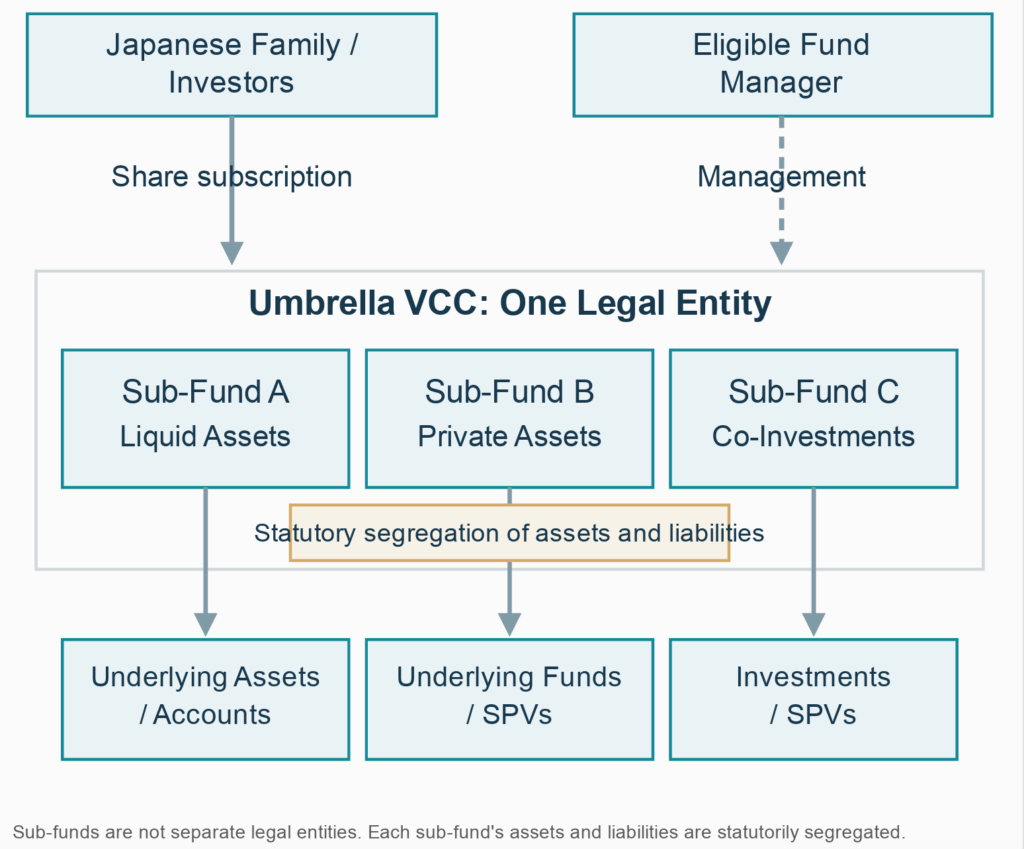
An umbrella VCC may share certain operational functions, including the board of directors and service-provider arrangements, potentially creating common operations compared with establishing a separate entity for each strategy. However, each sub-fund may still require administration, audit, tax compliance, banking arrangements, and other work. Actual total costs, establishment time, and operating requirements must therefore be compared for each case.
A VCC can issue and redeem investment shares based on net asset value (NAV) and has the flexibility to make distributions from capital. Its constitution, offering documents, and other documentation also allow investment structures with a range of features to be created.
A VCC must have an eligible fund manager that satisfies the requirements of the Variable Capital Companies Act. The precise licensing, registration, or exemption category that applies must be confirmed against the manager’s legal status, scope of business, and the rules in force when the VCC is established.
2 Treating the Issue as Appropriate Information Management Not Anonymity
It is natural for a family to prefer not to disclose its assets and investment policy unnecessarily to the general public. The fact that a VCC’s register of members is not publicly available is relevant to privacy in this sense.
However, information not being freely available to the public is entirely different from there being no obligation to disclose it to anyone. Registration information concerning the VCC’s name, officers, fund manager, and sub-funds is not treated in the same way as the register of members.
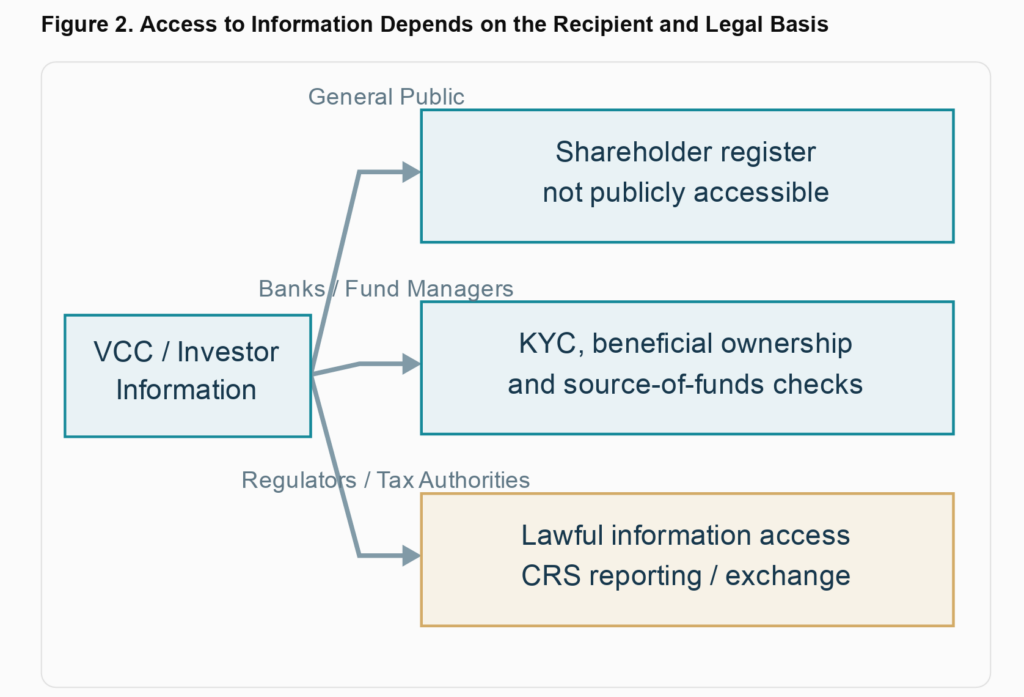
Banks, fund managers, and other institutions may identify investors and beneficial owners for Know Your Customer (KYC) and anti-money laundering purposes. Depending on the circumstances, they may also require documents explaining the source of funds and Source of Wealth, and the documents required by a bank may differ from those required by a fund manager. Establishing a VCC does not automatically secure the opening or continued maintenance of a bank account. An experienced and capable fund manager may assist with opening and maintaining the fund’s bank account.
The Common Reporting Standard (CRS), under which financial account information is exchanged among tax authorities, is a separate framework. Whether an entity is a Reporting Financial Institution and how interests or accounts are classified must be confirmed. The VCC label alone does not remove an arrangement from reporting. Japan’s National Tax Agency also publishes information on the automatic exchange of information under the CRS. Detailed classification and reporting requirements vary, and the fund’s response will depend on those requirements.
In this article, KYC means customer identification conducted by financial institutions and other entities. AML/CFT means measures to combat money laundering and terrorist financing. The Common Reporting Standard (CRS) is an international framework under which tax authorities automatically exchange specified financial account information.
The practical question is not how much information can be concealed. It is who obtains which information, for what purpose, and to whom it is reported. Access rights within the family, confidentiality obligations of external professional advisers, data storage, and cross-border data sharing should also be addressed.
3 Sections 13O and 13U and Tax Efficiency Where Does the Tax Burden Change
A VCC is a legal vehicle, not a tax incentive in itself. Singapore’s Sections 13O and 13U are fund tax schemes that, subject to approval and prescribed conditions, exempt specified income derived from designated investments. Establishing a VCC does not by itself make all income tax-exempt.
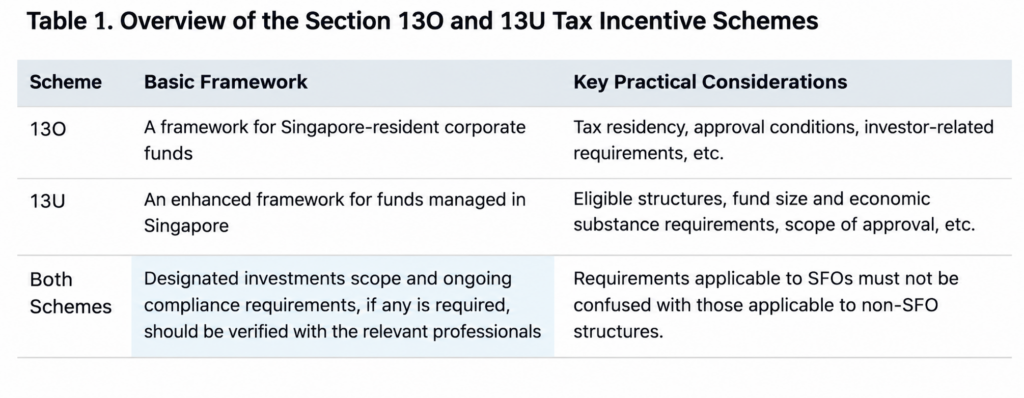

The requirements under both schemes include matters relating to the Singapore fund manager and investment management. It is important not to conflate eligibility of a manager under the Variable Capital Companies Act with the investment management requirements for tax incentives.
The scope of designated investments and any applicable ongoing compliance requirements should be assessed in light of the specific fund structure and approval conditions, and verified with the relevant professionals where necessary. In particular, requirements applicable to single-family offices (SFOs) should not be confused with those applicable to non-SFO fund structures.
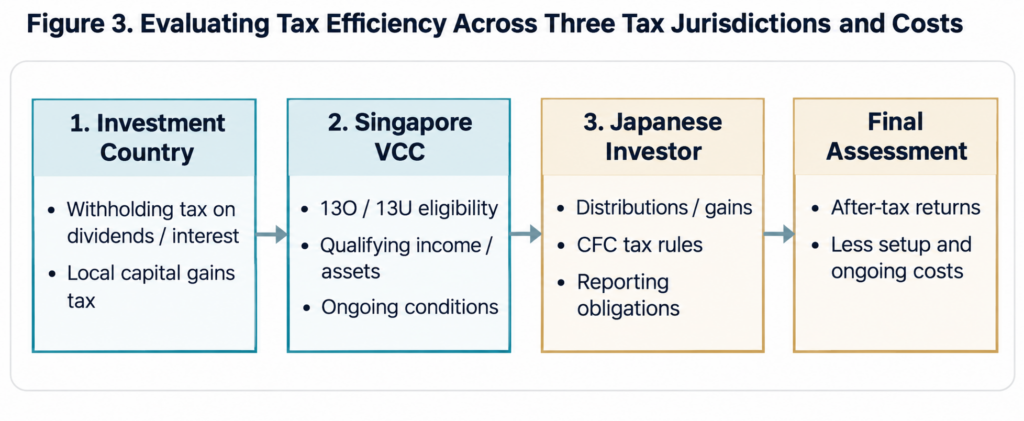
Although an umbrella VCC is generally treated as a single legal entity, Singapore’s tax treatment includes calculating income and tax separately for each sub-fund. The relevant filing obligations and application of tax incentives must be confirmed for each case.
Where the conditions are satisfied, there may be scope to reduce the Singapore income tax burden at the fund level and improve reinvestment efficiency. Singapore also does not impose withholding tax on dividends. This does not, however, eliminate tax in the investee jurisdiction or taxation of the Japanese recipient.
Dividends, interest, and other income from overseas investments may be subject to withholding tax in the investee jurisdiction. Access to tax treaty benefits requires consideration of tax residence, beneficial ownership, anti-avoidance rules, and other requirements. A Certificate of Residence alone does not guarantee treaty benefits. Gains from the sale of foreign assets must also be reviewed under the relevant provisions and exclusions, including Section 10L of the Singapore Income Tax Act.
4 Matters Japanese Investors Should Review First
Japanese Income Taxation Continues to Apply Separately
Individuals who are residents of Japan are generally taxed on worldwide income, subject to the exception for non-permanent residents. Japanese corporate investors must also consider Japanese corporate tax. Tax exemption in Singapore should not be assumed to eliminate the Japanese tax burden.
CFC Rules Require a Case-by-Case Assessment Based on Ownership and Control
Japan’s controlled foreign company (CFC) rules attribute the income of certain foreign companies to a Japanese taxpayer and tax it as Japanese income. The rules do not apply or cease to apply uniformly merely because a VCC is used. The analysis must consider who owns and controls the VCC and to what extent, the economic activities conducted locally, the nature of the income, the effective tax burden, and other factors. If the rules apply, Japanese taxation may arise before an actual dividend or distribution is received.
The relevant facts differ between a dedicated VCC and a fund with many independent investors. The ownership relationships involving family members and related parties, decision-making arrangements, and local operational substance must be organized and assessed. It is not possible to conclude uniformly that a VCC is outside the CFC rules or that a minority interest presents no issue.
Reporting Obligations and Marketing and Solicitation Rules Must Also Be Reviewed
Japan’s Statement of Overseas Assets must generally be filed by June 30 of the following year by a resident, other than a non-permanent resident, who holds overseas assets exceeding JPY 50 million at year-end. The valuation and location of VCC interests and other reporting obligations must also be considered.
Lawful establishment and operation in Singapore do not mean that marketing or solicitation in Japan is permitted without conditions. When an interest in a foreign corporate fund is introduced or sold to residents of Japan, its treatment under Japan’s Financial Instruments and Exchange Act and other applicable laws must be reviewed according to the legal nature of the product, the manner of solicitation and sale, and the registration status of the relevant parties.
The analysis does not end with whether a Singapore tax exemption is available. Japanese classification, CFC rules, income taxation, foreign tax credits, and reporting obligations must be assessed together. The absence of Singapore tax does not automatically create a foreign tax credit in Japan.
5 Illustrative Use Case and Circumstances in Which a VCC May Not Be Appropriate
The following hypothetical example is provided solely to explain the structure. It does not describe an actual client, recommend an allocation, or estimate a tax effect. Assume that a Japanese owner family that has sold its business wishes to divide its overseas investments among three purposes: short- to medium-term funding needs, long-term private investments, and co-investments with other investors.
In this case, it may be reasonable to establish separate investment policies, redemption terms, reporting methods, and cost allocations for each sub-fund.
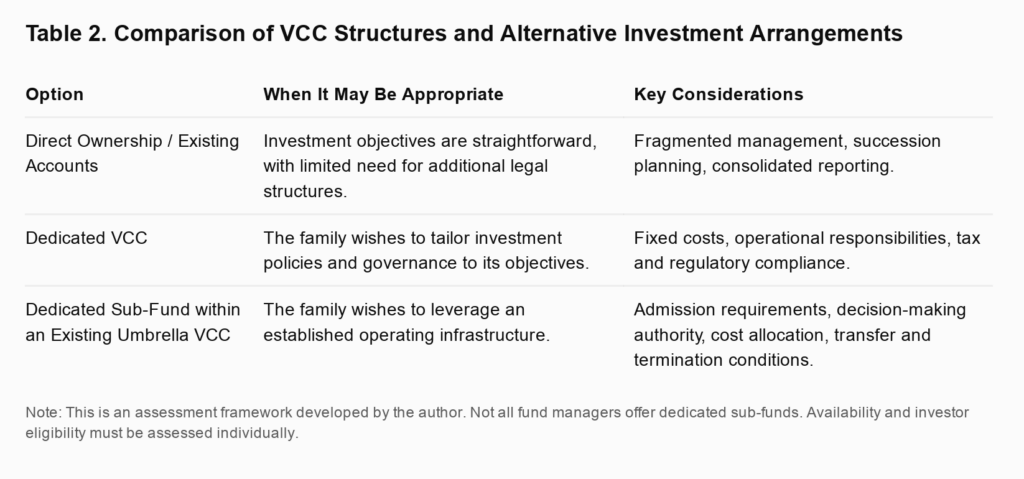
The significance of using Singapore lies in combining investment management companies, banks, fund administration, audit, legal, and tax functions to create an operating base for overseas investments.
A different method may be more appropriate if the investment amount does not justify the maintenance costs, the objectives are simple, or ongoing information provision and substantive operations are difficult. Costs to be compared include not only establishment and legal fees, but also investment management, administration, audit, directors and corporate secretarial services, banking and custody, tax compliance in Japan and Singapore, and termination costs.
Operating an overseas business company is not the same as operating a family investment fund. Where expansion into ASEAN markets or a business reorganization is involved, the structure may need to distinguish business responsibilities, the holding structure, and investor rights, with further planning and structuring. A VCC should not be viewed simply as a universal substitute for an operating company or succession planning.
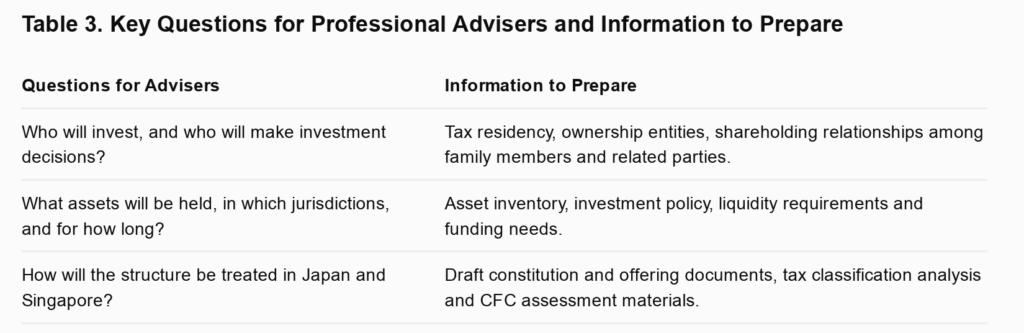
6 Questions and Materials to Prepare Before Establishment
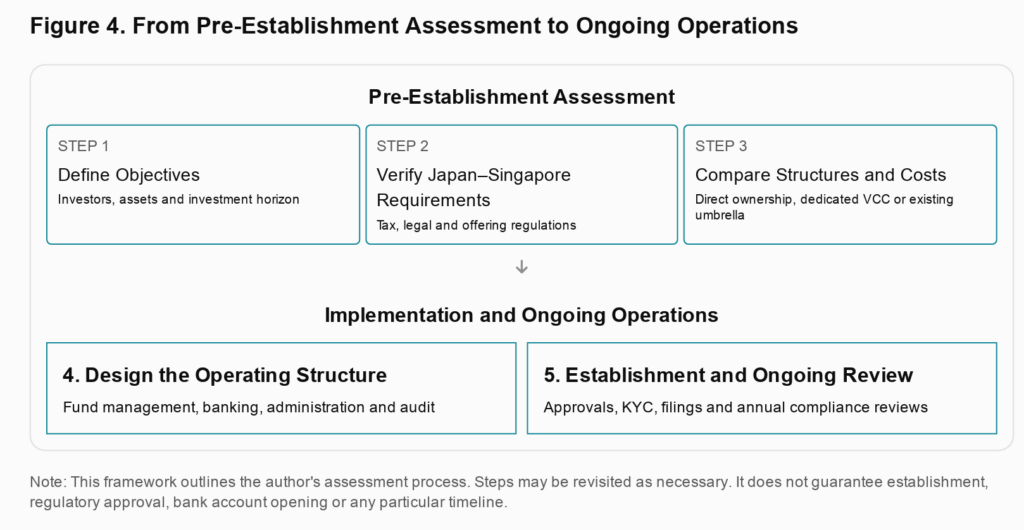
The initial consultation should not begin with an instruction to establish a predetermined vehicle. It should begin with materials that explain the family’s objectives and assumptions and allow the available alternatives, including the option not to adopt the structure, to be compared.
Conclusion Articulate the Family’s Policy Before Choosing a Vehicle
The value of a VCC and its sub-funds cannot be understood solely through low tax rates or non-public information. It lies in organizing the family’s investment objectives, identifying the risks that should be separated and the functions that can be shared, and sustaining the resulting operations.
When Japanese taxation and reporting are considered as well, the question of whether to use a VCC becomes the more practical question of which framework should support the family’s overseas investment management. Understanding the structure is the first step toward beginning that discussion.
Conflict of Interest and Disclaimer
The author’s firm, IWC Management Pte. Ltd., provides investment management and fund-related services and has a business relationship with the subject matter of this article. This article is intended to provide general information and does not constitute solicitation of any specific investment product, individual investment advice, or legal or tax advice. Laws, regulations, and applicable conditions may change. Before implementation, the relevant facts should be reviewed individually by professional advisers in each jurisdiction concerned.
FOPAJ Editorial Note
FOPAJ does not recommend the use of any specific scheme, investment product, asset management company, or service, including a VCC.
References
Reference date: September 24, 2026. The following are the principal references for this article. Legislation and regulatory materials were prioritized and are distinguished from conclusions for any individual case.
- ACRA, Understanding VCC features, eligibility and requirements. VCC features, standalone and umbrella structures, and the register of members.
- Singapore Statutes Online, Variable Capital Companies Act 2018, including Sections 16, 19, 29, 30, and 33. Legal personality, capital, and segregation of sub-funds.
- Sections 81 and 82 of the same Act. Maintenance, inspection, and provision of the register of members.
- MAS, Notice VCC-N01. AML/CFT requirements for VCCs, including identification of customers and beneficial owners.
- IRAS, CRS Overview and Latest Developments. CRS classification, due diligence, and reporting framework.
- IRAS, Tax Framework for Variable Capital Companies, Fourth Edition, April 22, 2026. Treatment of companies, distributions, sub-fund-level calculations, and fund tax schemes.
- MAS, Fund Tax Schemes for Family Offices. Guidance on tax incentives for SFOs. Conditions for SFOs should not be applied to non-SFOs.
- Sections 46 and 48 of the Variable Capital Companies Act. Requirements for eligible managers and directors. Current eligibility should be reconfirmed when the VCC is established.
- ACRA VCC Register, Business Profile. Guidance on registration information available for purchase.
- National Tax Agency of Japan, No. 2010 Individuals Subject to Tax. Scope of taxation for residents and other individuals.
- Articles 40-4 et seq. and 66-6 et seq. of Japan’s Act on Special Measures Concerning Taxation. Application of the CFC rules must be reviewed separately for individuals and companies.
- National Tax Agency of Japan, Automatic Exchange of Information under the Common Reporting Standard CRS.
- IRAS, Payments that are Not Subject to Withholding Tax. Singapore withholding tax on dividends.
- IRAS, Applying for a Certificate of Residence Tax Reclaim Form. Tax residence certificates and treaty application.
- IRAS, Tax Treatment of Gains or Losses from the Sale of Foreign Assets. Section 10L of the Income Tax Act. Individual application, exclusions, and interaction with tax incentives require separate review.
- National Tax Agency of Japan, F4-4 Statement of Overseas Assets including the summary form.
- Financial Services Agency of Japan, Warning against Fraudulent Investment Solicitation and Similar Conduct. Registration considerations for overseas businesses serving residents of Japan.
- IWC Management, Ken CHEW profile. The title is based on the firm’s public description.
- National Tax Agency of Japan, No. 1240 Foreign Tax Credit for Residents.
- MAS, Notice 626 Banks. Identification of customers and beneficial owners by banks and related requirements.
- Singapore Statutes Online, Income Tax Act 1947, including Sections 13O and 13U.
- IRAS, Multilateral Convention to Implement Tax Treaty Related Measures to Prevent BEPS. Anti-abuse measures relating to tax treaties.
- IWC Management official website. The firm’s own description of its services.